

The Rise of Nanobubble Technology
From Scientific Discovery to Industrial Innovation
Executive Summary
Water is rapidly becoming one of the world's most valuable industrial resources. Rising water scarcity, increasing energy costs, tighter environmental regulations, and growing sustainability expectations are forcing industries to rethink how they manage water.
Nanobubble technology has emerged as one of the most significant innovations in modern water treatment because it dramatically improves the way gases such as oxygen and ozone dissolve into water. Unlike conventional aeration systems, nanobubbles remain suspended in water for extended periods, allowing far more efficient gas transfer while reducing energy consumption and, in many applications, reducing chemical use.
Today, nanobubble systems are operating in aquaculture, agriculture, wastewater treatment, industrial processing, food production and environmental restoration across more than 55 countries. International ISO standards now define how nanobubbles are generated, measured and characterised, moving the technology from scientific curiosity to recognised industrial practice.
This article explains why nanobubble technology has become so important, how it evolved, and why organisations worldwide are increasingly adopting it as part of their water management strategy.
Key Takeaways
✔ Water scarcity is driving demand for more efficient water treatment technologies.
✔ Nanobubbles remain suspended in water far longer than conventional bubbles.
✔ Their exceptional gas transfer efficiency improves oxygenation and oxidation while reducing wasted energy.
✔ International ISO standards provide recognized terminology and measurement methods for nanobubble technology.
✔ Commercial adoption is accelerating across aquaculture, agriculture, wastewater treatment and industrial applications.
Table of Contents
Why Water Has Become Industry's Biggest Challenge
The Global Water Crisis
Why Chemical Reduction Matters
What Are Nanobubbles?
Why Nanobubbles Behave Differently
From Scientific Discovery to Commercial Deployment
Industries Already Using Nanobubbles
Market Growth
Frequently Asked Questions
Why Water Has Become Industry's Biggest Challenge
Water is no longer simply a utility. It has become a strategic resource affecting operational efficiency, regulatory compliance and long-term business resilience.
Across virtually every water-dependent industry, operators are facing similar challenges:
Increasing water costs
Rising energy prices
Stricter environmental regulations
Pressure to reduce chemical consumption
Higher sustainability expectations from customers and regulators
Traditional water treatment technologies have served industry for decades, but many are approaching their practical limits. Conventional aeration systems often waste a significant proportion of the gas they introduce because large bubbles rise rapidly to the surface before dissolving.
Nanobubble technology addresses this limitation by fundamentally changing how gases interact with water.
Instead of forcing more air into water, nanobubbles improve how efficiently that gas is transferred and retained.
The Global Water Crisis
Before understanding nanobubbles, it is important to understand why industries are actively searching for technologies like them.
According to the United Nations and the World Bank, global water demand continues to increase while available freshwater resources face growing pressure from population growth, industrial development and climate variability.
Some of the most important global facts include:
Approximately half of the world's population experiences water scarcity during at least part of each year.
Agriculture accounts for roughly 70% of global freshwater withdrawals.
Industry uses approximately another 20%.
Groundwater reserves are being depleted faster than natural recharge in many regions.
These trends are increasing both the cost and the strategic importance of efficient water management.
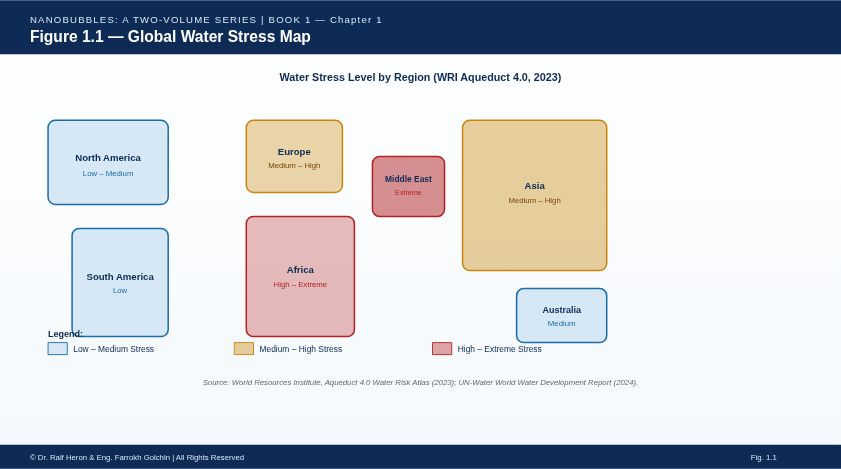
Global Water Stress Map
Why This Matters
For many industries, the question is no longer whether water efficiency should improve.
The question is how.
Technologies capable of producing better water quality while using less energy and fewer chemicals are becoming increasingly valuable across almost every industrial sector.
Nanobubbles have emerged precisely at this point in history.
Why Chemical Reduction Matters
Water scarcity is only one side of the challenge.
The second is chemical dependency.
Many industries rely heavily on chemicals to maintain water quality:
Aquaculture uses disinfectants, antibiotics and algaecides.
Agriculture relies on fertilisers and pesticides.
Wastewater treatment depends on chemical dosing.
Food processing requires extensive sanitation.
Industrial cleaning often consumes large volumes of cleaning chemicals.
Besides cost, these chemicals create environmental and regulatory challenges.
One of the most attractive aspects of nanobubble technology is that it does not introduce additional chemicals into the water.
Instead, it improves the physical behavior of the water itself.
Industry Insight
Nanobubble technology is fundamentally a physical treatment technology. Rather than replacing one chemical with another, it enhances gas transfer efficiency, allowing biological and oxidation processes to work more effectively.
Depending on the application, this can contribute to:
Reduced chemical consumption
Improved dissolved oxygen
Better biological performance
More sustainable water treatment processes
Importantly, the achievable benefits depend on the gas used, water chemistry and system design—not simply on the presence of nanobubbles themselves.
What Are Nanobubbles?
Most people are familiar with bubbles rising in sparkling water.
These visible bubbles are relatively large and quickly float to the surface before releasing their gas into the atmosphere.
Nanobubbles behave very differently.
They are typically less than 200 nanometres in diameter and are invisible to the naked eye.
Because they are so small, the forces acting on them change dramatically.
Instead of rapidly rising, nanobubbles remain suspended in water for extended periods, allowing the contained gas to dissolve far more efficiently into the surrounding liquid.
The result is a much higher gas transfer efficiency than conventional aeration technologies can typically achieve.
Table 1 – Bubble Types Compared
| Bubble Type | Typical Size | Residence Time | Gas Transfer | Typical Applications |
|---|---|---|---|---|
| Macrobubbles | >1 mm | Seconds | Low | Conventional aeration |
| Microbubbles | 10 µm–1 mm | Minutes | Moderate | Flotation and oxygenation |
| Nanobubbles | <200 nm | Hours to days | Very High | Precision oxygenation, water treatment, cleaning |
Adapted from ISO 20480 terminology and referenced scientific literature.
Why Nanobubbles Behave Differently
At first glance, nanobubbles might appear to be nothing more than extremely small versions of ordinary bubbles. In reality, they behave according to a very different set of physical principles.
This difference is what makes nanobubble technology valuable across industries such as aquaculture, agriculture, wastewater treatment and industrial water management.
Unlike conventional bubbles that quickly rise to the surface and release their gas into the atmosphere, nanobubbles remain suspended in water for extended periods. This dramatically increases the opportunity for oxygen, ozone or other gases to dissolve into the surrounding water.
The result is significantly higher gas transfer efficiency with less wasted energy.
Three Characteristics That Make Nanobubbles Different
1. Near-Neutral Buoyancy
Conventional bubbles are driven upward by buoyancy.
Nanobubbles are so small that buoyancy becomes almost insignificant compared with the surrounding molecular forces acting on the bubble.
Instead of rapidly floating to the surface, nanobubbles remain suspended throughout the water column, allowing the contained gas to continue dissolving over time.
For operators, this means the oxygen stays where it is needed instead of escaping into the atmosphere.
2. Electrostatic Surface Charge
Nanobubbles naturally carry a negative electrical surface charge, commonly referred to as zeta potential.
This electrical charge causes neighbouring bubbles to repel one another instead of merging together.
Without this stabilising mechanism, billions of nanobubbles would rapidly combine into larger bubbles and lose their unique behaviour.
Instead, they remain dispersed throughout the water, maintaining a stable population capable of continuous gas transfer.
Industry Insight
The stability of nanobubbles is not achieved by adding chemical stabilizers. It is an inherent physical property of the bubbles themselves.
3. Exceptionally Large Surface Area
As bubbles become smaller, their surface area increases dramatically relative to their volume.
This means that a given amount of gas can present far more contact area with the surrounding water.
More contact area creates more opportunity for gas molecules to dissolve into solution.
For oxygenation systems, this translates directly into improved oxygen transfer efficiency.
For ozone systems, it improves oxidation and disinfection performance.
Why This Matters in Practice
These three characteristics work together to create a technology fundamentally different from conventional aeration.
Instead of producing large bubbles that escape almost immediately, nanobubble generators create billions of microscopic gas carriers that remain distributed throughout the water.
The practical benefits include:
Higher dissolved oxygen levels
Improved oxygen transfer efficiency
Lower energy consumption
Reduced gas wastage
Better utilisation of injected gases
More consistent treatment performance
Exactly how these benefits translate into operational improvements depends on the gas selected and the application.
For example:
Oxygen nanobubbles support biological activity and improve dissolved oxygen.
Ozone nanobubbles enhance oxidation and disinfection.
Carbon dioxide nanobubbles can assist with pH management.
Hydrogen nanobubbles are currently being investigated for specialized agricultural applications.
The bubble itself is simply the delivery mechanism.
The gas determines the treatment objective.
Common Misconceptions About Nanobubbles
As nanobubble technology has gained attention, several misconceptions have become widespread.
"Nanobubbles are just tiny bubbles."
No.
Their stability, gas transfer behavior and electrical properties make them fundamentally different from conventional bubbles.
"Nanobubbles quickly float to the surface."
No.
"Nanobubbles burst almost immediately."
Unlike ordinary bubbles, nanobubbles can remain stable for hours or even days depending on water chemistry and operating conditions.
"Nanobubble systems require chemical additives."
False.
Nanobubble generation is a physical process.
No chemical stabilizers are required.
"Nanobubbles automatically create supersaturated water."
Not necessarily.
Like any oxygenation technology, dissolved gas concentrations remain measurable and controllable using standard water-quality instrumentation.
Correct system design and monitoring remain essential.
The Evolution of Nanobubble Technology
Scientific discovery rarely follows a straight path.
Nanobubbles are an excellent example.
When researchers first observed stable gas bubbles smaller than one micrometre, many scientists believed the measurements were incorrect.
According to classical fluid dynamics, bubbles that small should collapse almost instantly.
Yet laboratories around the world continued reporting the same observations.
As measurement techniques improved, evidence accumulated from independent research groups in Japan, Australia, Europe and North America.
What initially appeared to be experimental anomalies gradually became accepted scientific observations.
The debate shifted from "Do nanobubbles exist?" to "Why are they stable?"
That shift marked the beginning of nanobubble technology as an engineering discipline rather than simply an academic curiosity.
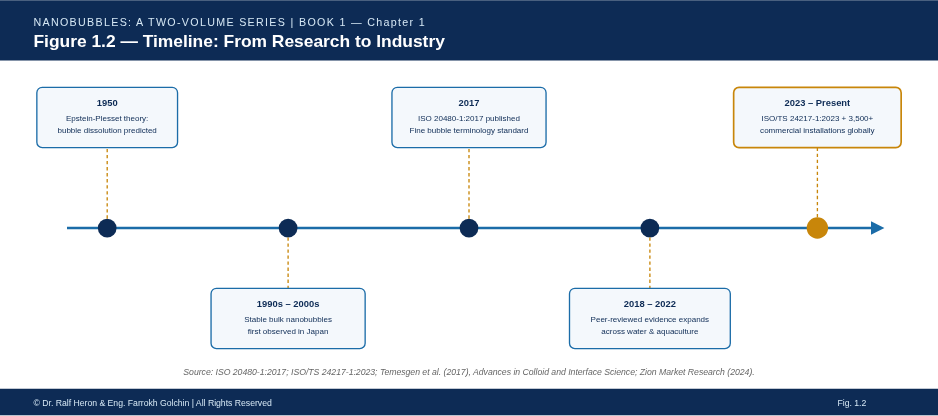
The development of nanobubble technology from laboratory discovery through international standardisation to global commercial deployment.
From Scientific Discovery to Global Industry
Nanobubble technology did not emerge from a marketing campaign or a single breakthrough invention. It evolved over more than two decades as scientists, engineers and industrial operators gradually recognised that extremely small gas bubbles behaved differently from conventional bubbles.
Initially, many researchers were sceptical. According to classical fluid dynamics, bubbles at the nanoscale should collapse almost immediately. Yet independent laboratories around the world continued reporting stable nanobubbles that persisted for hours—or even days.
As analytical techniques improved, evidence accumulated from Japan, Europe, Australia and North America. What had once been considered a laboratory anomaly became an accepted scientific phenomenon.
The question changed from:
"Do nanobubbles exist?"
to
"How can we use them to solve real industrial problems?"
That shift marked the beginning of commercial nanobubble technology.
The Importance of International Standards
One of the defining milestones in the industry's development was the introduction of international standards.
As scientific understanding improved, the need for consistent terminology and measurement methods became increasingly important.
The establishment of ISO Technical Committee 281 provided the framework for standardising fine bubble technology worldwide.
The publication of the ISO 20480 series gave researchers, manufacturers and end users a common technical language covering:
Terminology
Bubble classification
Generation methods
Measurement techniques
Performance evaluation
This standardization significantly increased confidence in the technology and accelerated commercial adoption.
Industry Insight
Technologies rarely become mainstream until they are standardised. International standards allow engineers, consultants and regulators to evaluate systems using common definitions and recognised testing methods.
Commercial Adoption Accelerates
Today, nanobubble systems are being used across more than 55 countries, supporting applications ranging from aquaculture and agriculture to wastewater treatment and industrial processing.
Several factors have driven this growth:
Increasing pressure to improve water efficiency
Rising energy costs
Stricter environmental regulations
Growing demand for sustainable production
Better understanding of oxygen transfer technology
The industry has also attracted significant investment from both specialist water companies and major multinational organisations.
This level of investment reflects growing confidence that nanobubble technology has moved beyond research and into practical engineering.
Why Better Measurement Changed Everything
Early nanobubble research produced inconsistent results because measuring structures smaller than one micrometer is technically challenging.
Different laboratories used different equipment, making comparisons difficult.
Modern analytical techniques have largely resolved these problems.
Today, the most widely used characterization methods include:
| Technique | Primary Purpose |
|---|---|
| Nanoparticle Tracking Analysis (NTA) | Measures bubble concentration and size distribution |
| Dynamic Light Scattering (DLS) | Determines average particle size and distribution |
| Atomic Force Microscopy (AFM) | Directly visualises nanoscale surface structures |
Combined with ISO measurement standards, these tools have transformed nanobubble science into a reproducible engineering discipline.
Industries Already Using Nanobubble Technology
One of nanobubble technology's greatest strengths is its versatility.
Unlike technologies developed for a single application, nanobubbles function as a gas delivery platform that can be adapted to many different industries.
The underlying physics remains the same.
Only the gas and the application change.
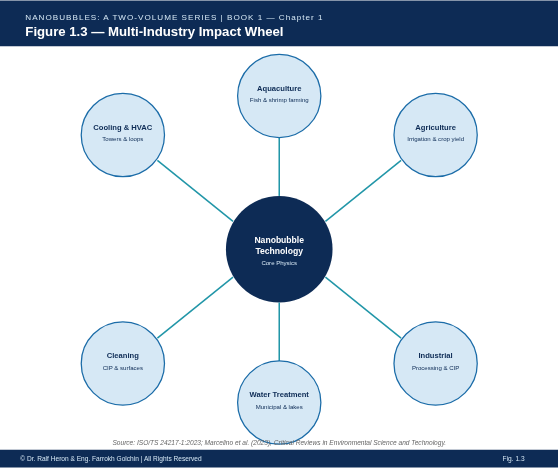
Nanobubble technology supports a wide range of industries by improving gas transfer efficiency for oxygenation, oxidation and specialised water treatment processes.
Aquaculture
Nanobubble oxygenation helps maintain dissolved oxygen levels that support healthy fish growth and biological stability.
Common objectives include:
Improved dissolved oxygen
Reduced fish stress
Better feed conversion
Higher stocking densities
More stable water quality
Aquaculture is now one of the most mature commercial markets for nanobubble technology.
Agriculture and Irrigation
Healthy roots require oxygen as well as water.
Nanobubble irrigation systems improve oxygen availability within the root zone while supporting more efficient nutrient uptake.
Potential benefits include:
Improved root development
Better crop uniformity
Reduced irrigation water consumption
Enhanced nutrient efficiency
Increased resilience during environmental stress
Wastewater Treatment
Wastewater treatment depends heavily on biological oxygen transfer.
By increasing oxygen transfer efficiency, nanobubbles can support:
Lower aeration energy requirements
Improved biological treatment performance
Reduced chemical dosing
Better process stability
Improved compliance with discharge standards
For many facilities, aeration is the single largest energy consumer, making improvements in gas transfer particularly valuable.
Environmental Restoration
Lakes, ponds and reservoirs frequently suffer from oxygen depletion.
Nanobubble systems are increasingly being used to:
Restore dissolved oxygen
Reduce anaerobic conditions
Support aquatic ecosystems
Improve overall water quality
Unlike traditional aeration systems, nanobubbles remain suspended throughout the water column, allowing oxygen to reach a much larger treatment volume.
Food and Beverage Processing
Food manufacturers use water throughout production.
Nanobubbles are being investigated and deployed for applications including:
Cleaning
Sanitation
Ozone-based disinfection
Shelf-life improvement
Water quality management
Because ozone naturally decomposes back into oxygen, ozone nanobubble systems may reduce reliance on conventional chemical disinfectants in appropriate applications.
Mining and Industrial Processing
Industrial facilities increasingly use nanobubbles for:
Mineral flotation
Produced water treatment
Scale management
Process water optimisation
Water reuse
The objective is generally the same:
Achieve higher process efficiency while reducing operating costs.
Why the World's Leading Water Organizations Are Paying Attention
The rapid adoption of nanobubble technology is not being driven by equipment manufacturers alone. It reflects a much broader shift in global thinking about water, energy and sustainability.
Three of the world's most influential organizations all identify the same priorities:
Improve water efficiency
Reduce energy consumption
Minimise chemical use
Increase resilience against water scarcity
Improve environmental sustainability
Nanobubble technology aligns closely with each of these objectives.
United Nations
The United Nations, through UNESCO and UN-Water, has repeatedly highlighted water scarcity as one of the defining global challenges of this century.
Key priorities include:
Improving water-use efficiency
Expanding wastewater treatment
Protecting freshwater resources
Supporting sustainable food production
These priorities directly support technologies that can transfer gases into water more efficiently while reducing resource consumption.
The World Bank
The World Bank's current water strategy is built around three themes:
Water for People
Water for Food
Water for the Planet
Across all three areas, improved water management is considered essential for future economic growth.
Industries are increasingly expected to produce more while using less water, less energy and fewer chemicals.
Nanobubble technology is one of several advanced water treatment technologies helping organisations meet these objectives.
FAO
The Food and Agriculture Organization (FAO) focuses particularly on agriculture and aquaculture.
Its latest reports show that global aquaculture production continues to expand rapidly while facing increasing pressure from:
Oxygen management
Water quality
Disease control
Sustainability requirements
Technologies that improve dissolved oxygen and water quality without increasing chemical use are becoming increasingly important for future food production.
A Technology That Supports Multiple Sustainability Goals
One reason nanobubbles have attracted interest across so many industries is that a single technology can contribute to several operational objectives at the same time.
Depending on the application, nanobubble systems may help organisations:
Improve oxygen transfer efficiency
Reduce aeration energy demand
Lower chemical consumption
Improve biological treatment performance
Enhance water reuse opportunities
Support more sustainable production
The exact benefits depend on system design, water chemistry and the application, but the underlying principle remains the same: improving the efficiency of gas transfer into water.
Market Growth Reflects Industry Confidence
The commercial market for nanobubble technology has expanded significantly over the past decade.
Growth has been driven by several converging trends:
Rising global demand for water treatment
Increased investment in sustainable technologies
Stricter environmental regulations
Growing interest in water reuse
Continued expansion of aquaculture and agriculture
Industry forecasts indicate continued strong growth throughout the coming decade, with demand expected to remain strongest in:
Aquaculture
Agriculture and irrigation
Wastewater treatment
Industrial process water
Environmental restoration
Growing investment by both specialist manufacturers and major international water technology companies suggests that nanobubbles are increasingly viewed as an established engineering solution rather than an emerging concept.
Where Homeport Fits
At Homeport, we focus on applying proven nanobubble science to real industrial challenges.
Our OxyFusion® Nanobubble Systems are designed for organisations looking to improve water quality, oxygen transfer efficiency and operational performance while reducing energy use and chemical dependency where appropriate.
Rather than offering a one-size-fits-all solution, we work with clients to evaluate:
Water quality
Process objectives
Flow rates
Oxygen demand
Industry-specific operating conditions
This application-focused approach reflects an important principle repeated throughout this knowledge base:
Successful nanobubble projects are built on matching the right gas, the right system and the right operating conditions to the specific problem being solved.
Industries Already Benefiting from Nanobubble Technology
One of the reasons nanobubble technology has gained global attention is its versatility. The same underlying science can solve very different water treatment challenges across multiple industries.
While each application has its own objectives, the principle remains the same: improve gas transfer into water more efficiently than conventional aeration methods.
Aquaculture
Aquaculture is one of the most established applications for nanobubble technology.
Fish and shrimp production depends heavily on maintaining adequate dissolved oxygen levels while controlling water quality and biological stability.
Potential benefits include:
Higher dissolved oxygen levels
Improved fish health and welfare
Better feed conversion efficiency
Reduced stress during periods of high stocking density
Lower disease pressure through improved water quality
Reduced aeration energy requirements in suitable applications
Homeport's OxyFusion® Nanobubble Systems are designed to deliver efficient oxygen transfer for commercial aquaculture, helping producers improve water quality while reducing operating costs where application conditions are suitable.
Agriculture and Irrigation
Healthy roots require oxygen as much as they require water.
In many irrigated soils, oxygen availability becomes a limiting factor for plant development, particularly where soils are compacted or heavily irrigated.
Nanobubble irrigation has been studied for its ability to improve root-zone oxygen availability.
Reported benefits include:
Stronger root development
Improved nutrient uptake
Better water-use efficiency
Higher crop quality
Increased yield potential under suitable conditions
Reduced dependence on some fertiliser and chemical inputs in specific applications
Results vary depending on crop type, soil conditions, irrigation method and overall farm management.
Wastewater Treatment
Wastewater treatment is another sector where nanobubble technology has demonstrated significant potential.
Biological treatment processes rely on oxygen to support aerobic microorganisms responsible for breaking down organic matter.
More efficient oxygen transfer can help facilities:
Reduce aeration energy consumption
Improve biological treatment efficiency
Increase dissolved oxygen stability
Improve compliance with discharge requirements
Reduce operational costs
Because aeration often represents the largest energy consumer in wastewater treatment plants, improving oxygen transfer efficiency can deliver substantial operational benefits.
Lakes and Environmental Restoration
Many lakes, reservoirs and ponds suffer from oxygen depletion, nutrient imbalance and seasonal algal blooms.
Nanobubble oxygenation can support environmental restoration by increasing dissolved oxygen without introducing chemicals.
Potential applications include:
Lake restoration
Pond rehabilitation
Algae management
Sediment oxygenation
Ecosystem recovery
Environmental projects generally require long-term monitoring because ecological recovery depends on many interacting biological and environmental factors.
Food and Beverage Processing
Food manufacturers increasingly seek technologies that improve hygiene while reducing chemical use.
Depending on the process, nanobubble systems may support:
Produce washing
Surface sanitation
Process water treatment
Equipment cleaning
Shelf-life improvement
Water reuse initiatives
Ozone nanobubbles are of particular interest because ozone is a powerful oxidising disinfectant that decomposes back into oxygen without leaving persistent chemical residues.
Mining and Industrial Water
Mining and industrial operations often require large volumes of treated process water.
Nanobubble technology has been investigated for applications including:
Mineral flotation
Produced water treatment
Scale reduction
Process water optimisation
Cooling water improvement
Each application requires careful engineering assessment, but improved gas transfer efficiency can contribute to both operational performance and sustainability objectives.
One Technology, Many Applications
Although these industries appear very different, they all share one common challenge: moving gases into water efficiently.
Whether the goal is to:
Grow healthier fish
Produce stronger crops
Improve wastewater treatment
Restore lakes
Enhance food safety
Optimise industrial processes
…the underlying engineering principle remains the same.
Nanobubbles create an exceptionally large gas–water interface, allowing oxygen, ozone or other gases to dissolve more efficiently than conventional aeration methods.
That versatility is one of the reasons nanobubble technology has become one of the fastest-growing innovations in industrial water management.
Why Businesses Choose Homeport
Homeport focuses exclusively on practical, commercial nanobubble solutions.
Rather than simply supplying equipment, we work with customers to understand:
Their process objectives
Existing water quality
Flow rates and hydraulic conditions
Oxygen demand
Energy consumption
Return-on-investment objectives
This engineering-first approach helps ensure every OxyFusion® Nanobubble System is matched to the application, because successful projects depend on selecting the right solution—not simply installing a larger generator.
Frequently Asked Questions
What exactly is a nanobubble?
A nanobubble is an extremely small gas bubble, typically less than 200 nanometres in diameter. Because of its size, it behaves very differently from ordinary bubbles, remaining suspended in water for extended periods and providing highly efficient gas transfer.
How are nanobubbles different from conventional aeration?
Conventional aeration produces relatively large bubbles that quickly rise to the surface, allowing much of the injected gas to escape into the atmosphere.
Nanobubble systems generate billions of microscopic bubbles that remain dispersed throughout the water, increasing the opportunity for gases such as oxygen or ozone to dissolve efficiently into the surrounding liquid.
Are nanobubbles suitable for every application?
No.
Like any engineering technology, nanobubbles must be matched to the specific application. Water chemistry, hydraulic design, gas selection, organic loading, temperature and operational objectives all influence performance.
Successful projects depend on correct system design rather than simply installing a larger generator.
Which gases can be used?
Several gases can be used depending on the treatment objective:
| Gas | Typical Purpose |
|---|---|
| Oxygen | Increase dissolved oxygen and support aerobic biological activity |
| Ozone | Oxidation, disinfection and advanced water treatment |
| Carbon Dioxide | pH management in selected applications |
| Air | General oxygenation where high-purity oxygen is unnecessary |
| Nitrogen | Specialised industrial and food processing applications |
| Hydrogen | Primarily an emerging research area in agriculture |
The gas—not the nanobubble itself—determines the treatment objective.
Are nanobubbles safe?
The nanobubbles themselves are not considered hazardous.
Safety depends on the gas being used.
For example:
Oxygen requires appropriate fire safety precautions.
Ozone requires suitable ventilation and worker exposure controls.
Carbon dioxide requires confined-space awareness where applicable.
These requirements follow established industrial safety standards rather than nanobubble-specific regulations.
Do nanobubbles replace chemicals?
Not necessarily.
In some applications they may reduce chemical consumption by improving oxidation or biological treatment efficiency.
However, they should not be viewed as a universal replacement for chemicals. Every application should be evaluated individually.
Are nanobubbles environmentally friendly?
Nanobubble systems can contribute to more sustainable water management by improving gas transfer efficiency, reducing energy consumption and, in some applications, lowering chemical usage.
The environmental benefits depend on how the technology is designed and operated.
Key Takeaways
Nanobubbles represent a significant advancement in gas transfer technology.
Their unique physical properties enable more efficient oxygenation and oxidation than conventional bubbles.
International ISO standards have helped establish nanobubble technology as a recognised engineering discipline.
Commercial adoption continues to grow across aquaculture, agriculture, wastewater treatment, food production and industrial processing.
Successful implementation depends on matching the correct gas, system design and operating conditions to each application.
Continue Your Learning
This article is the first in Homeport's Nanobubble Knowledge Centre.
Recommended next articles:
Nanobubbles Explained Simply
How Nanobubbles Are Generated
Nanobubbles vs Conventional Aeration
Choosing the Right Gas for Nanobubble Applications
Water Chemistry Fundamentals for Nanobubble Systems
How Homeport Applies This Technology
At Homeport, we believe successful nanobubble projects begin with sound engineering rather than product selection alone.
Our OxyFusion® Nanobubble Systems are designed around the scientific principles explained throughout this Knowledge Centre, with solutions tailored to each customer's operational objectives.
We support organizations across:
Aquaculture
Agriculture and irrigation
Wastewater treatment
Food and beverage processing
Industrial water systems
Environmental restoration
Every project begins with understanding the application, evaluating the water chemistry and selecting the appropriate gas, hydraulic design and monitoring strategy. This ensures the technology is matched to the problem rather than expecting one solution to fit every situation.
Homeport AI™ – Smarter Engineering Through Intelligent Design
At Homeport, we combine proven nanobubble science with Homeport AI™, our proprietary AI-assisted engineering platform developed to optimise nanobubble system design and performance.
Homeport AI™ assists our engineering team by analysing multiple design variables simultaneously, helping deliver more accurate, efficient and application-specific solutions.
The platform supports decisions including:
Gas selection (oxygen, ozone, air, carbon dioxide and other application-specific gases)
Generator sizing and capacity calculations
Generator positioning and installation layout
Hydraulic modelling and circulation optimisation
Oxygen transfer efficiency predictions
Energy consumption optimisation
Water quality modelling
Process performance forecasting
Environmental impact optimisation
Return-on-investment analysis
Rather than replacing engineering expertise, Homeport AI™ enhances it, allowing our engineers to evaluate complex scenarios more quickly and identify solutions tailored to each client's operational objectives.
Homeport has pioneered the use of proprietary AI-assisted engineering in the nanobubble industry, combining advanced engineering knowledge with intelligent analysis to deliver better outcomes for clients while supporting more efficient and sustainable water management.
Unlike many nanobubble systems that operate on ambient air, all Homeport OxyFusion® Nanobubble Systems are engineered with integrated high-purity oxygen concentrators. By generating approximately 98% pure oxygen on-site, OxyFusion® systems maximise oxygen transfer efficiency, improve dissolved oxygen performance and eliminate the ongoing logistics of oxygen cylinder supply for most applications.